What Is the Gartner® Magic Quadrant™ for B2B Pricing and Rebate Optimization?

Learn what the Gartner Magic Quadrant for B2B Pricing and Rebate Optimization covers, how Gartner defines the market, and what buyers should look for in pricing and rebate optimization software.
Pricing optimization and rebate strategies have grown infinitely more complex in recent years. Supply chain volatility has become the new normal. Tariffs are piling pressure onto already razor-thin margins. And profitability requires faster, smarter commercial decisions that legacy systems and processes simply weren’t built for.
That’s why we believe Gartner created the Magic Quadrant for B2B Pricing and Rebate Optimization: to help buyers understand the market for this increasingly important technology.
In this blog, we break down what we believe the Gartner Magic Quadrant for B2B Pricing and Rebate Optimization is, why we feel Gartner created it, how you can interpret it, and what buyers should look for when evaluating pricing and rebate optimization platforms.
Get instant access to the 2026 Gartner® Magic Quadrant™ for B2B Pricing and Rebate Optimization.
What is the Gartner Magic Quadrant?
A Gartner Magic Quadrant is a culmination of research in a specific market, giving you a wide-angle view of the relative positions of the market’s competitors. By applying a graphical treatment and a uniform set of evaluation criteria, a Magic Quadrant helps you quickly ascertain how well technology providers are executing their stated visions and how well they are performing against the market view held by Gartner.
Who is this Magic Quadrant for?
We believe the latest Gartner Magic Quadrant is for every team and business involved in commercial agreements. At a high level, there are three main types of organizations involved across industries:
- Manufacturers: Create the goods
- Distributors: Transport the goods
- Retailers: Sell the goods
Within these organizations, there are multiple departments and personnel involved, including:
- Pricing managers: Set prices and define pricing strategies
- Sales: Collaborate on agreements and influence how commercial agreements impact revenue
- Procurement: Negotiate better deals with suppliers, including special terms for long-term deals and transactions
- Finance: Use these platforms for accuracy and compliance
- Executives: Use these solutions for data-driven decision-making
Without a centralized platform, different departments inevitably work from different numbers, leading to misalignment and inefficiency, whereas a rebate and pricing optimization platform creates a shared source of truth that keeps everyone, inside and outside the organization, operating from the same trusted data.
Why do we believe Gartner is creating this Magic Quadrant?
According to the Budget Lab at Yale, effective tariff rates in the U.S. hit 17.9%, the highest since 1934. A study from McKinsey found that organizations were only able to pass off 45% of these tariff costs, meaning organizations are absorbing 55% through margins or other mitigation strategies. Supply chains remain volatile. Tariffs are forcing prices upward. As a result, rebates and pricing have become central to profitability.
McKinsey found that just a 1% price increase can lift operating profit by 14%, whereas the downside of suboptimal pricing is striking: A 5% price decrease requires around 21% more volume to break even.
That’s the macro context. Within organizations, the need for pricing and rebate management software is just as critical. Teams use an average of 24 systems to manage contract data. Without a centralized platform, reconciling all that contract data requires manually stitching together information from emails, spreadsheets, old systems, fragmented vendor conversations, and more. It’s not sustainable.
Then there’s the matter of AI-powered pricing optimization. The advent of smarter, more intuitive software, including platforms with automation, advanced analytics, and machine learning and AI built in, gives organizations a data-driven edge to see what’s working, what isn’t, and how they can take action to protect their margins. One study from BCG found that pricing innovators, the companies using data to optimize their pricing, expanded margins by more than 10 percentage points over two years while gaining market share.
Critical Capabilities and Use Cases listed by Gartner include:
- Price list management: Create and update a large number of list prices while helping users understand the impact of those changes before they’re made.
- Price optimization: Analyze patterns from historical data and deals to recommend prices and discounts to help the organization meet its goals, e.g., profit or revenue.
- Price execution: Provide a single point of price execution that works across every sales channel.
- Rebate management: Create, manage, track, and optimize rebate programs.
- Special price agreements: Help organizations negotiate and approve special price agreements.
- Long-term deal negotiation: Help businesses negotiate long-term deals, including incentives and commitments that help both sides win.
- Deal desk: Enable back-office teams to quickly process deal approvals and special pricing from the sales team, resellers, or customers.
- Global deployment: There has to be a single instance of the SaaS application that supports a global deployment across multiple countries, business units, languages, and currencies.
We believe every vendor included in this Magic Quadrant will help you optimize pricing and rebates, but not all of them will do it in the same way. You can trust that all the solutions are cloud-based and offer critical features that will help you execute pricing across channels and manage rebates to protect your margins, but each pricing optimization software company will vary in its more advanced or nuanced features and its long-term vision.
How does Gartner evaluate organizations in the Magic Quadrant?
Vendors that meet the core criteria are evaluated on 15 weighted criteria across two categories: Ability to Execute and Completeness of Vision. How each organization is evaluated in each category determines its placement on the Magic Quadrant.
The X Axis: What does Completeness of Vision mean?
We believe Completeness of Vision is about how well technology providers fulfill their stated visions. It’s a yardstick for how well organizations live up to what they aspire to be, what they promise to help customers achieve.
The weighted factors that influence this category include:
- Market understanding
- Product strategy
- Vertical/industry strategy
- Innovation
- Geographic strategy
The Y Axis: What does Ability to Execute mean?
We believe Ability to Execute looks at how well vendors perform against the market view held by Gartner. For this axis, Gartner also considers things like customer experience and market responsiveness.
The weighted factors in this category include:
- Products/services
- Overall viability
- Customer experience
- Operations
What do the four quadrants mean?
Dividing the X and Y axes into quadrants creates four distinct “quadrants,” each with its own strengths and weaknesses. If a vendor excels at its ability to execute but lacks vision, it’ll be placed in the Challenger quadrant. Likewise, if an organization has an incredible vision but lacks functionality today, it’ll likely fall into the Visionary quadrant.
Gartner says that by applying a graphical treatment and a uniform set of evaluation criteria, a Magic Quadrant helps you quickly ascertain how well technology providers are executing their stated visions and how well they’re performing against the market view held by Gartner.
Here’s a little more insight into what each quadrant means:
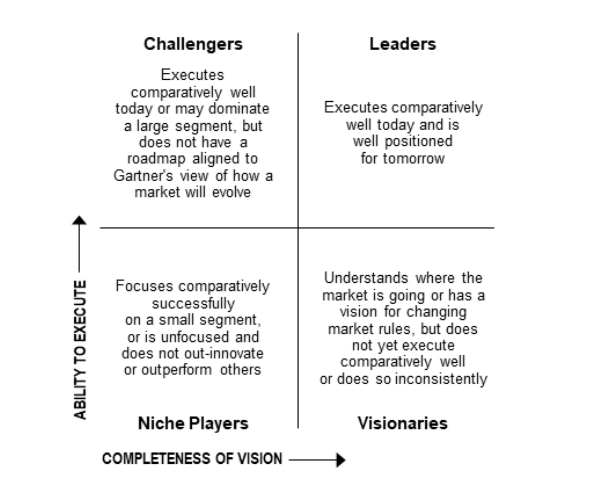
Source: Gartner Magic Quadrant
- Leaders execute well against their current vision and are well-positioned for tomorrow.
- Visionaries understand where the market is going or have a vision for changing market rules, but do not yet execute well.
- Niche Players focus successfully on a small segment, or are unfocused and do not out-innovate or outperform others.
- Challengers execute well today or may dominate a large segment, but do not demonstrate an understanding of market direction.
In B2B pricing and rebate optimization, these placements can mean different things. In our opinion, a Leader may combine strong execution in core capabilities like rebate management and price optimization with a clear vision for how commercial teams will work with AI. A Visionary may have a strong point of view on AI but have a limited track record in execution. A Challenger may deliver core functionality today but may lack a vision for AI-powered pricing and rebate optimization. And finally, a Niche Player may dominate a particular industry but not be a great fit for the market as a whole.
How should buyers read the Gartner Magic Quadrant for B2B Pricing and Rebate Optimization?
Buyers often wonder, “How does the Magic Quadrant work?” or “How do I read the Gartner Magic Quadrant results?” We believe Gartner Magic Quadrants are a valuable first step when evaluating technology providers for a new solution you plan to invest in.
It all comes down to your team’s specific needs.
In our opinion, a Visionary may have an innovation that fits your team’s goals better than a Leader’s. A Challenger may have the strongest ability to execute today, and that might be what matters most for your team. It all comes down to your needs and goals, and that’s what we believe makes the Gartner Magic Quadrant such a valuable starting place for market research.
What should buyers look for in pricing and rebate optimization platforms?
If vendors were included in a Gartner Magic Quadrant, that means they’ve already hit a pretty high threshold for functionality and execution. But you want to make sure you pick the right platform for your team. So, beyond starting with your team’s goals, what else should you look for?
Here are some important features to consider when evaluating pricing optimization tools:
A single source of truth for teams and partners
When departments are working from different numbers, misalignment can creep in and jeopardize decisions. Prioritize a pricing and rebate management platform that brings accurate data and insights to everyone in your organization, including sales, procurement, finance, and executive leadership.
The right platform should create a shared source of truth internally, and when necessary, create external alignment, giving vendors access to dashboards. With everyone working from the same numbers, everyone can track performance in real time. Everyone’s held accountable, and there are fewer disputes over things like calculations, eligibility, and fulfillment.
Less manual work, fewer costly errors
B2B organizations can manage hundreds, sometimes thousands, of agreements simultaneously. The right pricing and rebate management platform will automate a lot of that spreadsheet wrangling, eliminating a lot of errors that come from manually calculating rebates and deals. Fewer errors and fewer disputes mean stronger partner relationships.
AI-powered insights to protect your margin
Many vendors now have AI built into their platforms. Look for a platform that can model potential outcomes before agreements are signed. AI-powered pricing and rebate optimization platforms can forecast earnings based on historical performance, simulate multiple rebate and pricing scenarios, and spot deals that aren’t performing.
Real-time performance visibility
Waiting until the end of a quarter to measure how well a pricing strategy or rebate program worked means you’ll always be working from hindsight; you’ll always be leaving money on the table. Prioritize a pricing and rebate management platform that can give visibility into performance right when agreements begin. Real-time insights help you spot underperforming deals and double down on what’s working, letting you intervene before revenue and margin slip away.
Simplified compliance and auditability
AI regulations are ever-changing. Finance teams need clear documentation. Terms and payments need to be tracked and calculated and documented. While compliance is typically one of the most important and tedious parts of rebate management, AI-powered platforms can automate calculations and documentation, ensuring that every term, payout, and agreement is tracked accurately.
Enterprise-grade scale and connectivity
A platform can have strong capabilities on paper but still fail if it can’t fit into your tech stack or if it takes too long to deploy. Prioritize a platform that will plug in quickly and instantly connect with all your enterprise systems, including your ERPs and CRMs, giving you enterprise speed, scale, and connectivity.
Protect your margin. Start optimizing your pricing and rebates at scale.
We believe the new Gartner Magic Quadrant for Pricing and Rebate Optimization represents an inflection point in the market, a shift from manual, fragmented commercial processes to real-time, AI-powered insights that help B2B organizations make smarter, faster pricing and rebate decisions.
The right platform will depend on your specific needs: the complexity of your pricing and rebate strategies; your approach to AI; and your desire for enterprise speed, scale, and connectivity. Prioritize a vendor that will help you manage everything in one place while giving your teams the visibility and intelligence to protect your margins and unlock Commercial Intelligence at scale.
FAQs
What is the Gartner Magic Quadrant for B2B Pricing and Rebate Optimization?
A Gartner Magic Quadrant is a culmination of research in a specific market, giving you a wide-angle view of the relative positions of the market’s competitors based on their Completeness of Vision and Ability to Execute.
Why did Gartner create this Magic Quadrant?
Amidst rising supply chain volatility, surging tariffs, and complex deal terms, pricing and rebate management platforms have become a strategic part of commercial deals for everyone involved in the value chain, including manufacturers, distributors, and retailers.
What criteria do vendors have to meet to be included in the pricing and rebate optimization Magic Quadrant?
Gartner has several inclusion criteria, including cloud functionality and availability by a certain date, along with critical capabilities that each vendor must possess. These critical capabilities include price management, optimization, and execution; rebate management; support for special price agreements and long-term deals; functionality for back-office staff, and global availability.
What should buyers look for in pricing optimization software?
Prioritize a pricing and rebate optimization platform that provides a single source of truth for your teams and allows dashboard sharing for external transparency and alignment. Ensure the platform you choose automates rebate management, provides dynamic pricing optimization, gives AI-powered insights into deal performance and terms, has built-in auditability, and provides enterprise-grade connectivity and scale.
Gartner, Inc. Magic Quadrant for B2B Pricing and Rebate Optimization Software. 13 April 2026. Mark Lewis, Luke Tipping.
Gartner, Inc. Critical Capabilities for B2B Pricing and Rebate Optimization Software. 13 April 2026. Mark Lewis, Luke Tipping.
GARTNER and MAGIC QUADRANT is a trademark of Gartner, Inc. and/or its affiliates.
Gartner does not endorse any company, vendor, product or service depicted in its publications, and does not advise technology users to select only those vendors with the highest ratings or other designation. Gartner publications consist of the opinions of Gartner’s business and technology insights organization and should not be construed as statements of fact. Gartner disclaims all warranties, expressed or implied, with respect to this publication, including any warranties of merchantability or fitness for a particular purpose.
This graphic was published by Gartner, Inc. as part of a larger research document and should be evaluated in the context of the entire document. The Gartner document is available upon request from Enable.
Goodbye Spreadsheets. Hello Intelligent Pricing & Rebates.
Enable connects your pricing, rebates, and real-time analytics into an intelligent commercial system.