Understanding price waterfalls and protecting your margin
A price waterfall is a breakdown of all the deductions between your list price and the price you actually pocket after all contractual and operational
adjustments are applied.
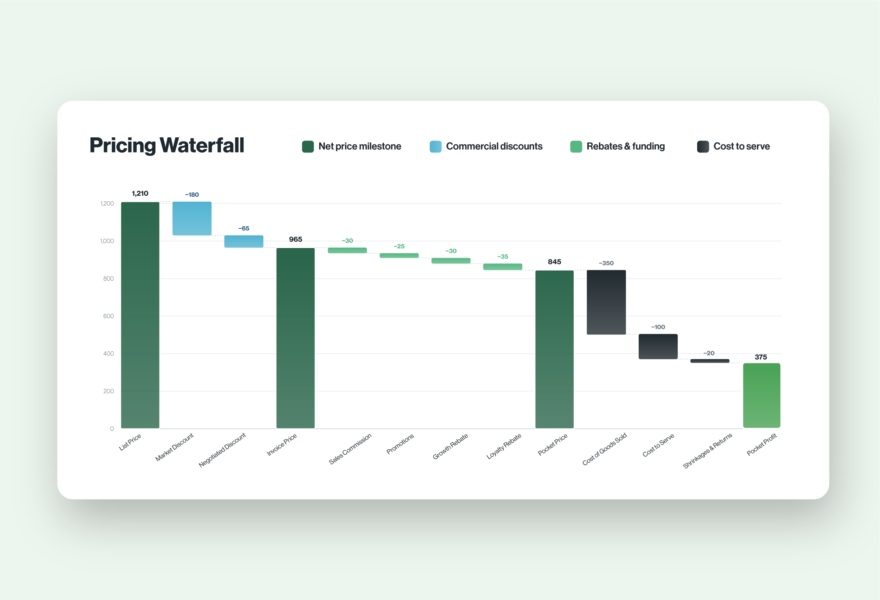
What is a price waterfall?
A price waterfall is a breakdown of all the deductions between your list price and the price you actually pocket after all contractual and operational adjustments are applied. It answers a straightforward but critical question: if you quote $100, how much of that $100 do you keep?
The waterfall separates adjustments into two groups, and understanding the distinction between them is where the analysis becomes actionable.
On-invoice adjustments are visible on the customer invoice and reduce what they’re billed. These include volume discounts for reaching purchase thresholds, standard channel or tier discounts, and negotiated customer-specific discounts. What remains after these on-invoice reductions is your invoice price. This is the number that most teams see and where most margin reporting stops.
Off-invoice adjustments happen after the invoice is sent, and they’re where visibility usually breaks down. These include rebate accruals tied to agreed performance or contract terms, promotional allowances for co-op and market development, freight and logistics adjustments, early-payment and settlement discounts, and product-, channel-, or region-specific incentives. What remains after both groups of adjustments is your pocket price. This is the net amount your business actually realizes once every commercial adjustment has been applied.
Let’s walk through a concrete example. A large automotive aftermarket distributor quotes $50 per unit to a key customer. Starting from that list price of $50.00, they apply a 5% volume discount because the customer is committing to 10,000 units annually, bringing the price down to $47.50. This is an on-invoice adjustment that appears on the invoice. After this on-invoice deduction, the invoice price is $47.50.
Then the off-invoice adjustments apply. The customer earns a 2% rebate on volume growth above 8%, which accrues at $0.94, leaving $46.55. The distributor funds a co-op allowance for the customer’s marketing campaign, reducing the price by $1.40 to $45.15. Freight and logistics adjustments subtract another $2.03 per unit, bringing it to $43.12. An early-payment discount of 1% brings it down by $0.43 to $42.69. After all adjustments, the pocket price is $42.69. The gap is $7.31, or 14.6%, between the starting list price and what the business actually realizes.
No single adjustment looks alarming in isolation. But together, they create a gap that most teams underestimate because two-thirds of it sits off-invoice. The invoice shows a 5% concession, but the actual transaction gave away 14.6%. A business measuring price realization only at invoice price understates its own erosion by nearly 3 times.
"We have better visibility of sales margins and greater accuracy in invoicing that is saving the business time and improving our cash flow."Tim Moore — COO of ANB Canada
Why the gap matters: from pocket price to margin
Pocket price is not the same as margin. To reach margin, you subtract the cost of delivering the product. This is where the waterfall stops being just a pricing exercise and becomes a profitability one. The critical insight is that cost does not move when price does. Every dollar of commercial adjustment comes straight out of margin, with no dilution and no offset.
Using the same automotive example with an illustrative unit cost of $34.00, the picture shifts significantly. At list price, your contribution margin is $16.00 per unit, or 32%. At invoice price, after just the on-invoice discount, you’re down to $13.50, or 28.4%. At pocket price, after all adjustments, you’re down to $8.69, or 20.4%.
Two critical numbers emerge from this comparison. First, a 14.6% reduction in price consumed 45.7% of your contribution margin. This reveals the mechanics of price erosion. At a 32% cost structure, every 1% you give away on price costs roughly 3.1% of margin. That multiple is the single most useful number in waterfall analysis, and it’s specific to your business.
You can calculate your own multiple by dividing 1 by your margin rate. A business running 32% margins converts price into margin at 3.1x. At 20% margins, it converts at 5x. At 10%, every 1% of price given away costs 10% of contribution margin. The thinner your margins, the higher the multiple climbs, and the more expensive each concession becomes.
Second, a team measuring margin only at invoice price believes it’s earning $13.50 when it’s actually earning $8.69. That’s an overstatement of 55%. This difference is the boundary between a deal that clears your margin threshold and one that doesn’t.
Across a 10,000-unit annual commitment, this waterfall gap translates to real margin dollars. Contribution margin falls from $160,000 to $86,900. That’s a difference of $73,100 on a single customer from adjustments that individually looked routine.
Not all of that gap is recoverable, and making this distinction is essential. The term “margin leakage” is used loosely in most organizations to describe the entire list-to-pocket gap, but that dilutes what it actually means. Margin leakage is only the recoverable subset. These are the adjustments that no longer earn what they cost. The rest is deliberate commercial investment, paying for something you actually wanted. Of that $73,100 gap, some is the price of doing business and some is genuine leakage. The purpose of waterfall analysis is telling them apart.
Getting this visibility right and keeping it current is the foundation of pricing confidence. Enable’s price waterfall capability was built to make this visibility a daily operational tool, not a quarterly reporting exercise.
See where your margin is leaking.
Learn how Enable helps you take control.
How to analyze your price waterfall
Building the waterfall gives you visibility. Analyzing it tells you where to act.
Start by choosing a scope that answers a specific question you need answered. Depending on what you’re trying to learn, that might be a customer segment, product family, channel, region, or group of similar agreements. Then separate on-invoice from off-invoice erosion before anything else. This distinction shapes everything that follows. If most of your gap is on-invoice, you have a discounting and approval governance problem. Sales is likely making discretionary discounts that should be policy-governed or escalated. If most of your gap is off-invoice, as is true in most B2B businesses and in the example above, you have a visibility and rebate management problem. No amount of discount governance will solve it.
Compare the gap across your chosen scope, then convert it to margin dollars, not percentages. This is the step most analyses skip, but it matters enormously. A 12% gap on a high-cost product destroys more margin than a 20% gap on a high-margin product. Looking for patterns within your scope is more valuable than chasing the largest single percentage. Do customers with similar buying behavior produce similar waterfall shapes? Do comparable products or channels land at materially different pocket prices?
When you’ve identified where the gap sits, rank line items by margin dollars at risk, not by percentage. The largest percentage is rarely the biggest problem. A modest adjustment applied across high volume exposes more margin than a large concession used selectively. It’s crucial to weigh size against reach. You might find that a 0.5% rebate on a high-volume customer costs more margin than a 3% rebate on a small account.
Then trace every material adjustment back to its original commercial purpose. If a rebate exists to encourage volume growth, is the structure still tied to that outcome? If you fund a promotional allowance, what is the business receiving in return? If an early-payment discount exists to improve cash flow, is the trade-off still worth the margin? This step matters most for long-standing agreements. A term can be entirely reasonable when negotiated and still outlive the relationship, market, or objective that justified it.
Finally, compare the waterfall you intended with the price that was actually executed. A sound pricing decision still loses value if rules are interpreted differently across channels, applied in the wrong sequence, or updated in one system and not another. Pricing, Sales, and Finance should be looking at the same adjustments and arriving at the same margin outcome. When they don’t, that gap is where margin disappears in execution.
A useful analysis leaves you with clear answers to 5 questions. Where is price being reduced, and how much of it is off-invoice? Which adjustments put the most margin dollars at risk? Are those adjustments still earning the intended commercial value? Are the approved terms being applied as intended? Which transactions fall below your margin threshold once every adjustment is applied? Once you’ve answered these, you have a roadmap for where margin is actually leaking and where you have room to recover it. If you’re building your first waterfall and need detailed step-by-step guidance, the comprehensive guide to building a pocket price waterfall covers data preparation, element definitions, and calculation frameworks in detail.
Strategies for optimizing your price waterfall
The goal is not to remove every concession. It’s to make sure each adjustment still earns the margin it costs. Give every one of them a test.
Tier and segment by margin contribution. Broad segments like enterprise, mid-market, or small business rarely explain the true economics of a customer relationship. Two customers buying the same product produce different pocket prices and different margins because of volume, service requirements, rebate structures, channel, and negotiated terms. Use your waterfall analysis to compare customers with similar buying behavior and find where their margin diverges. Does each tier’s margin contribution justify the terms that tier receives? Segmentation should reflect commercially meaningful differences, not organizational convenience. When you get this right, you recover margin without cutting off revenue.
Reset rebates against the behavior they buy. Rebates are usually the largest off-invoice line item, which makes them the largest source of invisible erosion. Review whether each rebate still drives the behavior it was designed to influence and whether the terms suit the current relationship. A rebate without a clear purpose should be restructured, renegotiated, or retired. The waterfall gives everyone the same view of what a rebate costs in margin, so the conversation runs on data rather than precedent.
Tie promotional spend to measurable outcomes. Co-op, market development, and similar allowances often become recurring line items long after their original purpose fades. Showing promotional spend inside your waterfall puts its margin cost directly beside every other commercial investment. Use that visibility to ask what the allowance is meant to achieve, how the outcome gets measured, and whether it still deserves its place. The waterfall won’t prove a program caused a result, but it will tell you exactly what you’re spending. Teams that enforce this rigorously recover 1 to 2% margin over 12 months.
Price the early-pay discount against your cost of capital. An early-payment discount trades margin for cash timing, and the math is checkable. A 1% discount for payment 30 days early works out to roughly 12% annualized. If your cost of capital is meaningfully below that, you’re overpaying for the cash and paying for it out of margin. Review who actually takes the discount, whether payment behavior changes when they do, and whether the terms still fit your working-capital position.
Model the waterfall before you quote. A proposed deal can look healthy at invoice price and land somewhere very different once off-invoice terms apply. The 55% difference in the automotive example above is not unusual. Because every adjustment hits margin one for one, small concessions stack faster than they’re immediately felt. Model how proposed terms affect pocket price and margin across the relevant order sizes, products, and scenarios before committing. Compare alternatives and put the trade-offs in front of whoever approves the deal. Teams that model waterfalls before quoting new customer deals recover 2 to 3% margin by adjusting terms early.
Software and tools for price waterfall management
Most waterfall analysis starts in a spreadsheet. For defining the calculation, exploring historical data, or reviewing a handful of transactions, a spreadsheet works fine. But it breaks down as complexity grows with large numbers of customer-product relationships, layered on- and off-invoice incentives, different rules by channel or region, frequent agreement changes, and pricing data spread across multiple systems.
The core problem isn’t the spreadsheet itself. It’s the distance between analysis and execution. By the time data has been collected, reconciled, and reviewed, you’re explaining last quarter’s margin instead of protecting next quarter’s. As one AV technology distributor put it: “The big problem with most ERP applications is you’ll know the sales value but you don’t know where all the rebate values are, so you don’t really know the true cost. That’s where Enable gives you the edge in the market—because you get a true assessment of your actual values across your suppliers, customers, and your whole relationship management.”
The right tool brings every relevant adjustment into one gross-to-net view. It traces pocket price and margin back to the terms that produced them, compares price realization across meaningful groups, and applies agreed pricing rules consistently as transactions occur. When evaluating tools, ask which on- and off-invoice adjustments it supports. How does it connect to the systems where pricing is managed and executed? How current is the underlying transaction and agreement data? Can users inspect the rules behind a calculated price? Is the sequence in which adjustments apply configurable and auditable? How easily can teams compare waterfalls across customers, products, and channels? Can it carry cost through to margin, or does it stop at net price? Can Pricing, Sales, and Finance work from the same economic view?
The objective isn’t a cleaner report. It’s connecting pricing intent to price execution, because you can’t hold a margin threshold you can’t see at the moment the price is executed. Enable gives Pricing and Finance teams real-time visibility into the gross-to-net waterfall while executing complex on- and off-invoice pricing at enterprise scale. You see how commercial adjustments shape pocket price and apply pricing rules consistently across transactions. Both sides of the invoice line matter, and they’re usually handled by different systems. On-invoice price execution lives in one place, off-invoice incentives in another, and everything gets reconciled after the fact. Enable covers both, which makes it possible to assemble the full waterfall in a single view.
Businesses moving down this path describe the shift in similar terms. ANB Canada centralized pricing, rebates, and co-op programs to get real-time visibility into sales margins and identify margin leakage. Tim Moore, COO of ANB Canada, described it simply: “We have better visibility of sales margins and greater accuracy in invoicing that is saving the business time and improving our cash flow.” MKM moved to monitoring through-margin performance before month end rather than after it, giving them time to act on pricing decisions while they still matter.
Next steps
Understanding your price waterfall shows you how individual commercial decisions combine into the margin your business actually earns.
Build your first waterfall. Start with one customer segment, product family, or channel. Define the starting price, separate on-invoice from off-invoice adjustments, calculate the pocket price, and take the extra step to margin. Aim for consistency and visibility before precision. When you do this right, you often find what Safety Express found: $204K in unaccrued rebates once the programs were properly tracked. The step-by-step guide to building a pocket price waterfall walks through data preparation, element definitions, and calculation frameworks.
Move from analysis to action. Pick the adjustment putting the most margin dollars at risk, or the one with the weakest commercial rationale. Decide whether the next step is deeper analysis, a pricing-policy change, an agreement review, or a customer conversation. Then measure the margin impact over 90 days. Visibility alone surfaces more than teams expect.
Bring your waterfall into daily operations. As complexity grows, connect the waterfall to the systems that execute your commercial terms. The closer the analysis sits to the transaction, the sooner teams see pricing outcomes diverge from intent. The more of the gap is still recoverable when they do. This is where Enable empowers commercial teams: real-time gross-to-net visibility while executing complex on- and off-invoice pricing at enterprise scale.
Ready to see how Enable brings price waterfall visibility into daily operations? Schedule a demo to explore how your organization can protect margin through pricing and rebate transparency.
Questions leaders ask us
If you don’t see your question here, our team can usually answer it in one call.
Ask our teamList price is the published or reference price before customer-specific adjustments. Pocket price is the net price realized after every applicable discount, rebate, allowance, and other commercial adjustment. The gap between them is the price waterfall, and on a typical transaction it’s wider than most teams expect.
Invoice price is what remains after on-invoice discounts, which is the number on the document the customer receives. Pocket price is what remains after off-invoice adjustments too including rebates, allowances, freight, and payment incentives. The distinction matters because most erosion is off-invoice. A business measuring realization at invoice price sees only a fraction of what it actually gave away. On the automotive example in this guide, invoice price showed a 5% concession against an actual 14.6%.
No. Pocket price is a price; margin is what remains after you also subtract the cost of delivering the product. The distinction matters because cost doesn’t change when price does, so every dollar of commercial adjustment reduces margin one for one. That’s why a 14.6% reduction in price can remove 45.7% of contribution margin.
Margin leakage is the portion of the list-to-pocket gap that no longer earns what it costs. These are the adjustments still being applied out of habit, inherited terms, or poor visibility. It’s not the whole gap. Most of that gap is deliberate commercial investment. Separating the two is the whole point of waterfall analysis, and any number presented as total leakage without that separation is overstated.
Start with list price or another consistent reference price. Subtract on-invoice discounts to reach invoice price, then subtract off-invoice adjustments including rebate accruals, promotional allowances, freight, and payment incentives. Apply them according to the rules and sequence in the agreement. What remains is pocket price. To reach margin, subtract the relevant product and service costs, taking care not to double-count anything already deducted in the waterfall.
Quarterly is the practical floor for most businesses. It lines up with financial close and gives you 4 chances a year to act. Review sooner when you introduce a major agreement, launch a new incentive, enter a new channel or region, or change pricing policy. Businesses with high transaction volume or layered incentives need visibility at the transaction level rather than the quarter. By the time a quarterly review surfaces a problem, a quarter’s worth of margin has already been priced.
Usually because they start from different prices. Sales tends to work from invoice price and product cost. Finance also accounts for accrued rebates, allowances, freight, and other off-invoice terms. On a typical transaction that difference is large. Margin at invoice price can overstate margin at pocket price by half. Neither number is wrong for its purpose, but only one of them is actual margin. A shared waterfall makes the difference explicit so the teams reconcile the calculation instead of defending competing versions.
Yes, and it’s one of the highest-value uses. A proposed waterfall shows how planned discounts, rebates, allowances, and terms will affect pocket price and margin before you commit. It lets you compare scenarios across expected order sizes and agreement structures. It should inform the decision rather than make it. Competitive context, customer value, expected volume, service requirements, and cost all still matter.
Learn more about Enable for pricing and rebates.
Gartner® Market Guide for B2B Profit Optimization Software
Learn the latest trends in B2B pricing and profit optimization strategy.

The 2026 Commercial Intelligence Landscape

35x ROI and Eliminates £2M by Modernizing Rebate and Pricing Management