Margin optimization: how rebates and pricing work together
The margin you protect is just as valuable as the revenue you generate. Here’s how to take control of both.
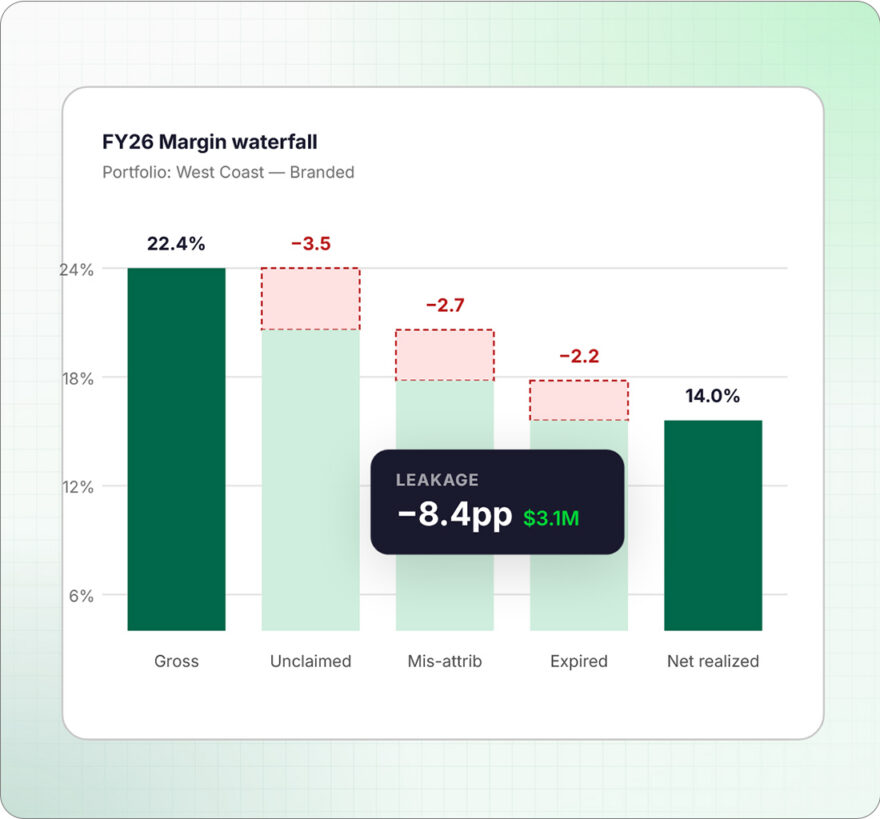
The hidden margin problem costing businesses millions
Every year, manufacturers, distributors, and retailers invest heavily in pricing strategies and rebate programs designed to drive growth. Prices are set, agreements are negotiated, and expectations for margin are built into every deal.
Yet by the end of the quarter, the reality often falls short. Margin hasn’t disappeared because of a single bad decision — it has eroded through hundreds of small, hard-to-detect gaps: a pricing concession made without visibility into existing rebate commitments, a supplier rebate that was earned but never claimed, a missed threshold that could have unlocked additional revenue, or accruals based on estimates instead of actual performance.
Individually, these issues seem minor. At scale, they compound into a significant and largely preventable margin problem. This is the cost of treating pricing and rebates as separate disciplines. Margin optimization is the practice of closing that gap — understanding not just how you price, but how every incentive, agreement, and adjustment impacts what you actually keep.
Most businesses manage pricing and rebates independently. The result is predictable: margin is lost in the space between them.
What is margin optimization?
Margin optimization is the ongoing process of maximizing profitability across every transaction by managing all components that impact margin — from initial pricing decisions to post-sale incentives like rebates. In B2B commerce, this is significantly more complex than simply setting the right price.
Gross margin
Gross margin reflects the difference between revenue and cost of goods sold. It’s the number most organizations anchor on — clean, comparable, and easy to report. But it stops short of the full commercial picture.
Net margin
Net margin accounts for additional costs and adjustments beyond COGS. It’s a more accurate reflection of profitability, but it still doesn’t capture the incentives and rebates that move after the invoice is cut.
Pocket margin
Pocket margin — or true margin — represents what your business actually retains after all discounts, rebates, allowances, and deductions. While most organizations focus on gross margin, pocket margin is what truly matters.
The price waterfall: where margin is won or lost
The journey from list price to pocket margin is often referred to as the price waterfall. At each step — list price, invoice discounts, promotional pricing, freight and allowances, customer rebates, supplier rebates, deductions and chargebacks — margin is adjusted. Without full visibility into this waterfall, businesses are effectively making decisions with incomplete information.
See where your margin is leaking.
See how Enable helps you take control of rebate-driven margin.
The two levers of margin: pricing and rebates
Margin optimization is ultimately controlled by two interconnected levers: pricing and rebates. Understanding each in isolation is not enough — the real impact comes from how they interact.
Pricing as a margin driver
Pricing is the most immediate and visible lever of margin. It includes list prices, customer-specific agreements, volume tiers and discounts, promotional pricing, and channel-specific strategies. But pricing decisions are often made without full visibility into rebate commitments — and that creates risk.
A discount that looks acceptable at the invoice level may become unprofitable once rebates are applied. A pricing strategy designed to win volume may unintentionally erode margin when combined with off-invoice incentives. Manual, spreadsheet-driven workflows make this worse: the result is outdated prices, inconsistent execution, and gradual margin erosion.
Rebates as a margin driver
Rebates are frequently misunderstood as a back-office function. In reality, they are a critical component of margin optimization — and they fall into two categories: supplier rebates (buy-side), which represent earned margin based on purchasing behavior, and customer rebates (sell-side), which represent strategic investment designed to drive volume, loyalty, or product mix.
Supplier rebates only deliver margin if they’re accurately tracked and claimed. Customer rebates only deliver growth if they’re structured and monitored effectively. One of the most valuable — but often overlooked — practices is near-miss analysis: identifying opportunities where a small change in behavior could unlock additional rebate revenue.
| Lever | What it controls | Common failure mode |
|---|---|---|
| On-invoice pricing | List prices, customer-specific agreements, volume tiers, promotional pricing, channel strategy. | Discounts granted without visibility into rebate commitments. |
| Off-invoice incentives | Adjustments that occur after the transaction — rebates, allowances, deductions. | Outcomes only understood after the fact. |
| Supplier rebates | Margin earned based on purchasing behavior with upstream partners. | Unclaimed rebates and missed tier thresholds. |
| Customer rebates | Incentives offered to drive volume, loyalty, or product mix. | Incorrect accruals and disputes over calculations. |
How rebate management impacts margin
Rebate management plays a central role in margin optimization — yet it is often one of the least controlled areas of the business. Without structured processes and visibility, rebates become a source of leakage rather than a driver of profitability. Platforms like Enable help organizations bring control, accuracy, and insight to rebate management.
- Eliminating rebate leakage. Automating rebate calculations and tracking ensures that earned rebates are actually collected — and that customer rebates are paid accurately.
- Real-time visibility. Tracking performance against agreements in real time allows teams to act before opportunities are lost.
- Better commercial decisions. Access to accurate rebate data enables more informed negotiations, smarter program design, and improved financial forecasting.
- Stronger partner relationships. Shared visibility reduces disputes and builds trust between trading partners.
The shift is simple in principle but transformative in practice: rebates stop being a back-office reconciliation exercise and start being a measurable, managed component of commercial strategy.
Explore intelligent pricing with Flintfox by Enable.
Advanced pricing at speed and scale — with margin visibility built in.
How pricing systems impact margin
Pricing systems are equally critical to margin optimization: they determine how margin is created at the point of sale. Advanced pricing platforms — like Flintfox by Enable — help organizations manage complex pricing at scale, without losing visibility into what each decision actually costs.
Pricing at speed and scale
Handle large volumes of pricing data across customers, products, and channels with accuracy and consistency. The alternative — a patchwork of spreadsheets and rigid ERP logic — is the root cause of most inconsistent execution.
Improved margin visibility
Understand the margin impact of pricing decisions before they are executed. When pricing teams can model a concession against live rebate commitments, margin becomes a design input rather than an after-the-fact discovery.
Omnichannel consistency and continuous monitoring
Keep pricing aligned across every sales channel to reduce discrepancies and leakage, and track margin performance over time so trends and outliers surface early — not at quarter-end.
Why alignment between pricing and rebates matters
Margin optimization does not require pricing and rebates to exist in the same system — but it does require them to be aligned. When they aren’t, discounts may unintentionally stack with rebates, supplier funding may not offset customer concessions, and margin is only understood after transactions are complete.
When they are aligned, pricing decisions reflect full incentive structures, rebate programs support overall commercial strategy, and margin becomes predictable and controllable. That alignment is what enables businesses to move from reactive margin management to proactive margin optimization.
Revenue growth matters — but protecting margin matters just as much. Every missed rebate, pricing error, or lack of visibility represents lost profitability. By aligning pricing and rebate strategies, businesses take control of their commercial performance.
Questions leaders ask us.
If you don’t see your question here, our team can usually answer it in one call.
Ask our teamIt is the practice of maximizing profitability by managing all components that impact margin — including pricing and rebates — across every transaction.
Put another way: most organizations manage pricing and rebates independently. Margin optimization is the discipline of managing them together, so what happens after the invoice doesn’t quietly undo what happened at the invoice.
Gross margin is revenue minus cost of goods sold. Pocket margin reflects the true profit after all adjustments — discounts, rebates, allowances, deductions, and chargebacks — are applied.
Most organizations report and incentivize on gross margin, but pocket margin is what the business actually keeps.
Supplier rebates increase margin — but only if they’re accurately tracked and claimed. Customer rebates reduce margin, but can drive growth when they’re structured and monitored effectively.
Unclaimed rebates, pricing errors, and a lack of visibility across commercial agreements are the primary causes. Manual processes and disconnected systems compound the problem at scale.
The price waterfall shows how margin changes from list price to final realized value. Without it, you’re making pricing and rebate decisions with only a partial view of what each one actually costs.
It automates the processes that break down at scale — rebate calculations, accruals, price execution — and it brings pricing and rebate data into a single view, so teams can make better decisions before commitments are made.
Keep learning about margin optimization.
Gartner® Market Guide for B2B Profit Optimization Software
Learn the latest trends in B2B pricing and profit optimization strategy.

The 2026 Commercial Intelligence Landscape

35x ROI and Eliminates £2M by Modernizing Rebate and Pricing Management