What is cost-plus pricing and how to build a strategy
Cost-plus pricing is a strategy where you calculate your total cost of goods sold and add a fixed markup percentage to determine the selling price. Building an effective strategy requires current cost data, consistent margin targets, regular price updates, and ongoing margin tracking.
Overview
Most teams think cost-plus pricing is solved. Add your cost, add your margin, ship it out. But that simplicity is also its trap. When you’re not tracking cost changes in real time, when you can’t adjust margins quickly across product tiers, or when your sales team doesn’t know the profitability of each deal, your “simple” pricing strategy becomes a slow leak of margin no one catches until quarter-end.
Cost-plus pricing works. The method is sound. The problem isn’t the strategy itself—it’s the visibility. When you lose sight of what’s actually happening to your costs and margins, you lose control of profitability. That’s what separates teams that hit their margin targets from those that leave money on the table every quarter.
We have better visibility of sales margins and greater accuracy in invoicing that is saving the business time and improving our cash flow.Tim Moore — COO of ANB Canada
What is cost-plus pricing
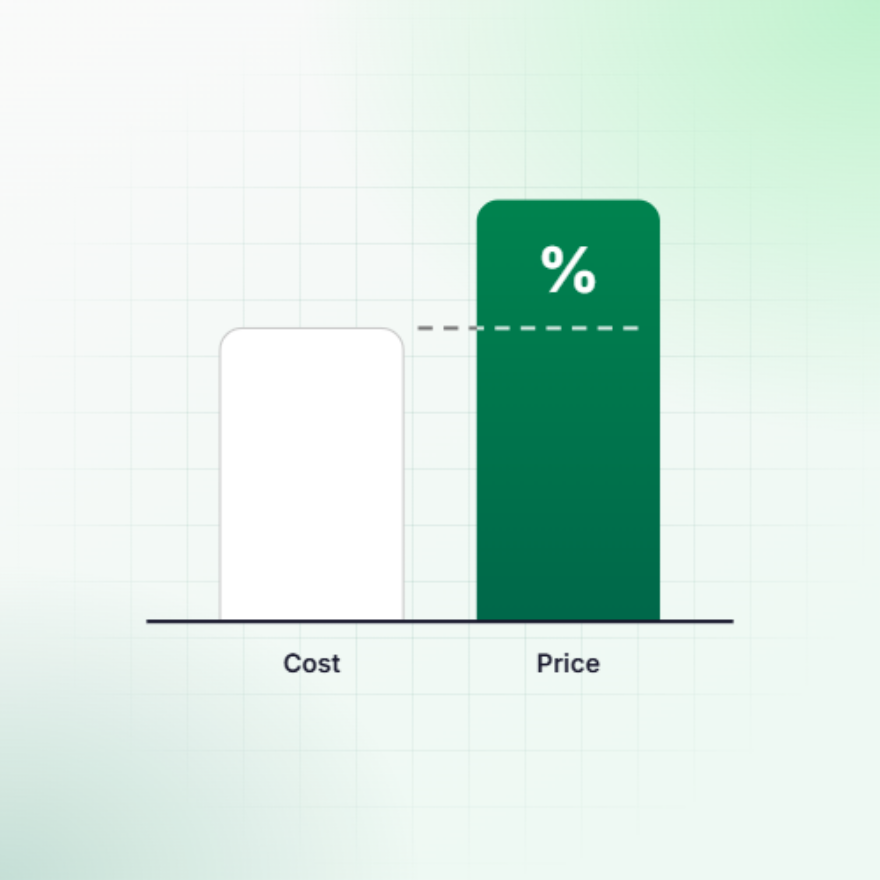
Cost-plus pricing takes your cost of goods sold and adds a markup percentage to create the selling price. The formula is straightforward: Selling Price equals Cost plus (Cost times Markup %). If you manufacture a product that costs you $100 to make and you apply a 20% markup, you price it at $120. You cover your costs. Your profit is built in. You can apply the same logic to 500 SKUs or 5,000.
The reason cost-plus pricing dominates across manufacturing, distribution, and retail is clear. It’s predictable, it’s transparent, and it doesn’t require you to guess what the market will bear. But here’s what breaks it in practice: the formula assumes your cost data is current, your margins don’t drift, and your deals actually deliver the profitability you calculated. In a perfect world, all three are true. In most organizations, none of them are.
Improve your margins
Learn how Enable helps you take control.
How to calculate cost-plus pricing
The calculation is simple in theory. The challenge is getting the inputs right.
Start with your actual cost of goods sold. This is not the standard cost from your ERP six months ago. Pull your landed cost from your last 30 days of purchases. Landed cost includes the supplier’s invoice price, inbound freight, tariffs or duties, receiving fees, and any other cost to get the product into your warehouse. Subtract rebates and volume incentives you’ve actually qualified for, not estimated.
Next, decide your markup percentage. This is typically expressed as a percentage of cost. A 30% markup means you add 30% of the cost on top of the cost. The formula is: Selling Price = Cost + (Cost × Markup %).
Example: If your cost is $100 and your markup is 30%, the math is: $100 + ($100 × 0.30) = $100 + $30 = $130. Your selling price is $130.
Some teams think in terms of margin instead of markup. Margin is the profit expressed as a percentage of selling price. If you prefer to think in margins (e.g., 25% margin), you need to convert. The relationship is: Markup % = Margin % ÷ (1 − Margin %). A 25% margin equals a 33% markup. Use whichever language your team speaks, but be consistent so pricing doesn’t drift.
The real work isn’t the math. It’s keeping your cost data current and your markup policy consistent. Teams that price quarterly or annually and apply the same markup to everything lose margin every quarter because costs move and no one tracks it.
Examples of cost-plus pricing
Cost-plus pricing appears across every industry. Here’s how it works in practice.
Manufacturing
A pump manufacturer calculates the cost of a mid-range unit by adding materials ($180), direct labor ($95), and allocated production overhead ($60) for a total cost of $335. At a 45% markup, the list price is $485.75. This holds steady until steel prices move. A 12% increase in materials takes the cost to $356.60. If the price list doesn’t move with it, the markup has quietly dropped to 36%. The salesperson doesn’t know. The finance team doesn’t know. By quarter-end, the margin target looks like a miss caused by volume or competition, when really it was a cost change no one tracked.
Building materials distribution
A building materials distributor receives lumber and steel from multiple suppliers. Their cost includes purchase price, inbound freight, any volume rebates they’ve qualified for, and warehouse handling. They apply a 35% margin target across their product mix. When a major supplier offers a 2% early-pay rebate, they hit that tier. But they don’t update their cost basis for pricing new orders, so they’re underpricing products relative to what they’ll actually pay. Alternatively, they assume they’ll hit the rebate but don’t, and they’ve overpriced their inventory. Either way, margin target and actual margin diverge by the time they do month-end close.
Electrical distribution
An electrical distributor prices at 25% margin across wire, switches, and panels from multiple suppliers. Their cost includes purchase price, tariffs on imported goods, and landed freight. They price quarterly based on average costs from the prior quarter. But material costs move monthly. In months when prices rise, they’re overmarked. In months when prices fall, they’re giving away margin. They don’t know which until closing, and by then they can’t adjust.
Services
A consulting firm calculates project cost by adding consultant hours at fully-loaded rates ($150/hour × 200 hours = $30,000), software licenses ($2,000), and allocated admin overhead ($3,000) for a total cost of $35,000. At a 30% markup, the project price is $45,500. The problem is the same as in other industries. If your cost accounting is manual and slow, you price conservatively by building in extra buffer, or you price based on assumption rather than actuals. Either way, you leave money on the table or you lose deals to competitors who price tighter.
Advantages and disadvantages of cost-plus pricing
Cost-plus pricing has clear strengths and real weaknesses. For a comprehensive breakdown of cost-based pricing as a category and how it compares to value-based and competitive approaches, see our cost-based pricing strategy guide.
Advantages
Cost-plus pricing is simple to understand and apply. You don’t need sophisticated pricing software or deep market analysis. One rule (cost plus 30%) can price thousands of products instantly. That’s powerful when you have a large catalog.
It’s transparent and defensible. When costs rise and you need to raise prices, you can explain the increase with hard data. Most customers accept this more readily than a price move with no justification. Credibility matters in B2B relationships.
It ensures you cover your costs. You’re never guessing whether a deal is profitable at a given price. If you price at cost plus your target margin, you know you’re covered—assuming your cost data is accurate and current.
It scales predictably. As your business grows and you add product lines or customer segments, you can apply the same logic. You don’t need to rebuild your pricing model for every new line of business.
Disadvantages
Cost-plus pricing ignores what customers will actually pay. In markets where customers value differentiation or outcomes, cost-plus pricing leaves money on the table. You could charge twice as much for a specialized product, but if your strategy is cost-plus at 30%, you won’t.
It doesn’t account for competitive pressure. If a competitor cuts their price, cost-plus doesn’t help you respond quickly. You’re locked into your margin target even if the market moves.
It requires constant cost updates. If you don’t track cost changes frequently, your margins drift. This is where cost-plus breaks down at scale. At 5,000 SKUs, staying on top of cost changes becomes a bottleneck.
It doesn’t distinguish between high-value and low-value products. A highly differentiated product and a commodity product might have the same cost structure, but they can support very different prices. Cost-plus treats them the same.
Cost-plus pricing strategies
There are multiple ways to apply cost-plus pricing depending on your business model and market. For a deeper look at specific strategies and execution techniques, see our article on using cost-plus pricing effectively.
Standard markup strategy
Apply the same markup percentage to all products. A 30% markup across the board is simple and fast. This works for commodity products or when you have limited differentiation. The risk is that you overprice low-value items and underprice high-value items.
Tiered markup strategy
Use different markups for different product categories or tiers. High-volume, low-complexity products get a 20% markup. Specialty products get 40%. This reflects the reality that different products support different margins. Most mature pricing teams use some version of this approach.
Customer-based strategy
Apply different markups to different customer segments or order sizes. A large distributor customer might get a 20% markup because they buy volume. A small retail partner might get a 35% markup because the sales cost is proportionally higher. This aligns pricing with the value you create for each customer.
Why cost-plus pricing fails at scale
The formula is simple. The execution breaks down in four ways that compound over time.
Cost data isn’t current. You price based on last month’s landed costs or last quarter’s standard cost. By the time you ship, material prices have moved. You’re chasing a moving target, always one step behind the market. You can’t adjust margins quickly across the portfolio. You have a 30% margin target, but when costs move, recalculating price for 2,000 SKUs is a spreadsheet nightmare. So you don’t do it. Margins drift downward as costs rise but prices lag behind.
Rebates and incentives aren’t modeled into your actual cost. Supplier rebates, volume discounts, and early-pay incentives reduce your true cost, but only if you track them and claim them correctly. If you don’t account for them in real time, you either leave money on the table or price assuming rebates you won’t receive. Finally, you don’t know which deals are actually profitable. Sales quotes a price based on the cost-plus formula, but by the time the deal closes and ships, the cost basis has changed. The deal that looked profitable at quote is now margin-neutral. You won’t know until month-end closing, and by then it’s too late to adjust.
These aren’t failures of cost-plus as a method. They’re failures of visibility at scale. The pricing logic is sound. The problem is you can’t keep up with what’s actually happening.
How to implement cost-plus pricing correctly
Step 1: Build your real cost base
Start with your accounting system, but don’t stop there. Your cost needs to include direct material cost (what you actually paid your supplier, not standard cost from six months ago), freight and landed cost adjustments like inbound shipping, tariffs, and duties, and labor allocated to the product (production labor for manufacturers, receiving and handling for distributors). Add overhead allocation like facility, equipment, and quality control spread across units produced, then subtract supplier rebates and volume incentives you’ve actually qualified for, not assumed.
This last point is critical. If Supplier A offers a 2% volume rebate at 100,000 units and you do 98,000, you don’t get it. Your actual cost is higher than your calculated cost. Pricing based on the 2% rebate would be a mistake. Get specificity here. Don’t use standard costs from six months ago. Pull actuals from your last 30 days of purchases. Understand which rebates you’ve actually qualified for and which you’re chasing.
Step 2: Decide your margin target and stick to it
Your margin target should reflect your competitive position (are you the low-cost provider or a premium player?), your cost structure (service-heavy businesses need higher margins than high-volume, low-touch distribution), your risk tolerance (longer sales cycles or higher inventory justify higher margins), and market reality (a 50% markup in retail food is fiction; in specialty distribution, it’s reasonable).
Don’t set a margin and then make exceptions for deals, competitors, or “special circumstances.” Exceptions become the rule. You end up with an average margin two to four points below target, and you never know why. Document your target by category or product tier. If you sell both commodity and specialty products, they may have different targets. That’s fine, but define it explicitly and apply it consistently.
Step 3: Calculate and update prices regularly
Once you have current costs and a margin target, the arithmetic is simple. But execution requires discipline. Update prices monthly or quarterly, depending on how fast your costs move. A manufacturer with volatile material costs should review prices monthly. A retailer with stable sourcing might review quarterly. The rule is this: if your cost moves more than two to three percent between reviews, your review cycle is too long. More frequent reviews protect margin but create customer communication challenges. Find the rhythm that keeps you ahead of cost changes without constantly changing prices.
Apply the formula consistently. Don’t let sales override pricing because “we need the deal.” If you need the deal at a lower margin, that’s a strategy decision, but it should be intentional and rare, not the default. Communicate price changes to your sales team before they happen. When costs rise and prices need to rise, sales gets blindsided. Prepare them for the reason, the timing, and the magnitude.
Step 4: Track actual vs. target margin
This is where most teams fail. They set a margin target and assume they hit it. Instead, measure monthly. Calculate gross margin by product, category, and customer. Are you hitting your 30% target, or are you at 28%? Where’s the gap? Analyze margin by cost driver. Is the gap from material costs rising? From rebates not materializing? From deals priced below standard? Investigate variance from plan. If your margin was supposed to be 30% and it’s 27%, figure out why. Was it planned or unplanned?
Tracking this monthly lets you adjust pricing or operations before the damage compounds.
How Enable helps you execute cost-plus without the manual work
Cost-plus pricing looks simple in theory. In practice, it requires staying on top of three moving pieces: your costs, your margins, and your deals. When you’re managing 500 or more SKUs, dozens of supplier agreements, and complex rebate terms, spreadsheets become a bottleneck.
Enable solves this by giving you commercial intelligence—real-time visibility into what’s actually happening with your costs, margins, and deals. Enable pulls your cost data from your ERP or accounting system and surfaces it in one place. You see current landed cost for each product, updated as you receive new invoices and supplier data. You see supplier rebates and volume incentives you’ve actually qualified for, not estimated. You see cost changes flagged in real time so you can decide whether to adjust price.
Instead of pricing based on last quarter’s cost standard, you’re pricing based on what you actually paid last week. Consider a building materials distributor who prices a product at $100 (cost $75, 33% margin). Three weeks later, the supplier raises their cost to $80. Without Enable, the distributor doesn’t know they’re still selling at $100, which is now a 20% margin. With Enable, that cost change surfaces immediately. The distributor can decide whether to reprice to maintain 33% margin or accept lower margin as a competitive move. Either way, they’re making an intentional choice, not bleeding margin by accident.
Enable calculates gross margin and shows you where you’re hitting target and where you’re not. You see margin by product, category, customer, or deal. You see margin trend over time. You see deals that were quoted at one margin but shipped at another, so you can tighten your quoting process. This visibility lets you spot problems before they become quarter-end surprises.
Rebates reduce your actual cost, but only if you track them and claim them correctly. Most teams either leave rebates on the table or don’t account for them when pricing the next order, treating rebates as windfall instead of cost structure. Enable’s rebate tracking and reconciliation means you see which rebates you’ve qualified for and how much they’ll reduce your cost. You can model rebate scenarios (what if we hit Tier 2?). You claim rebates on time and account for them correctly in your cost basis. Rebates move from “hope we get lucky” to “part of our cost strategy.”
Instead of pricing once and hoping it holds, Enable lets you set margin targets by category, generate price lists that reflect current costs and your margin target, and see whether a deal quote holds the margin you need before you send it to the customer. You track deals from quote to shipment so you know if what you sold at is what you actually achieved. A distributor quoting a large deal to a customer can see that this deal hits their margin target at current costs, but if material costs rise 5% before shipment, margin drops to 24%. Now the sales team can decide whether to lock in the price with the customer now or wait and accept margin risk.
Enable automates the workflows that usually live in email and spreadsheets. Supplier rebate reconciliation shows you what you earned, what you’ve claimed, and what’s pending. Price approval workflows ensure a manager reviews and approves price changes before they go live. Deal margin validation checks that pricing meets margin policy before a quote goes out. This keeps cost-plus pricing consistent and reduces errors.
Questions leaders ask us
If you don’t see your question here, our team can usually answer it in one call.
Ask our teamCost-plus pricing works well when your costs are stable and predictable and when your market doesn’t reward differentiation. It’s ideal for commodity products and for businesses where customers care most about price and reliability. If your market is highly competitive or cost-driven, cost-plus pricing with tight margin discipline is often the only sustainable approach. If your products are highly differentiated or your customers value outcomes over price, you might layer in value-based pricing on top. Either way, you need to know your true cost to start.
That depends on how fast your costs move. A manufacturer with volatile material costs should review prices monthly. A retailer with stable sourcing might review quarterly. The rule is that if your cost moves more than two to three percent between reviews, your review cycle is too long. More frequent reviews protect margin but create customer communication challenges. Find the rhythm that keeps you ahead of cost changes without constantly changing prices.
Your margin target depends on your industry and competitive position. Retail food runs 15 to 25%. Specialty distribution might be 30 to 40%. High-complexity manufacturing can support 40 to 50%. The benchmark that matters is what your competitor’s margin needs to be to stay in business in your category. Price too high and you lose volume. Price too low and you can’t cover costs. Your margin target should be the lowest sustainable margin that keeps you profitable after accounting for the cost of sales, marketing, support, and R&D.
That’s a signal that either your costs are out of line with your market pricing or you’re operating inefficiently. Cutting margin to gain volume sometimes works in the short term. But if you can’t hit your target consistently, investigate what’s happening. Are your costs legitimately higher than competitors? Are you paying more for materials than you should? Is your sales process inefficient? Are you over-serving low-margin customers? Margin targets aren’t wishes; they’re diagnostics. If you can’t hit yours, something in your cost structure or positioning needs to change.
Transparency and timeliness work. When costs rise, communicate the driver and magnitude to your sales team first so they understand the reason. When customers push back, you can explain that material costs from suppliers rose 8%, you’ve absorbed what you can, but you need to pass some of that through. Most customers accept cost-driven price increases if you explain them clearly and give advance notice. They’ll even accept them if they trust you. Credibility comes from consistency—showing that you’re not randomly raising prices, but responding to real cost changes.
Learn more about Enable for pricing and rebates.
Gartner® Market Guide for B2B Profit Optimization Software
Learn the latest trends in B2B pricing and profit optimization strategy.

The 2026 Commercial Intelligence Landscape

35x ROI and Eliminates £2M by Modernizing Rebate and Pricing Management