Price execution software
The 2026 buyer’s guide for manufacturers and distributors
Overview
Pricing has outgrown spreadsheets, disconnected ERP tables, and manual approvals. For manufacturers and distributors, the work doesn’t stop at setting the right price. The business has to apply that price at the right point in the transaction, for the right customer, under the right contract, with the right rebate, approval, accrual, and margin guardrail attached.
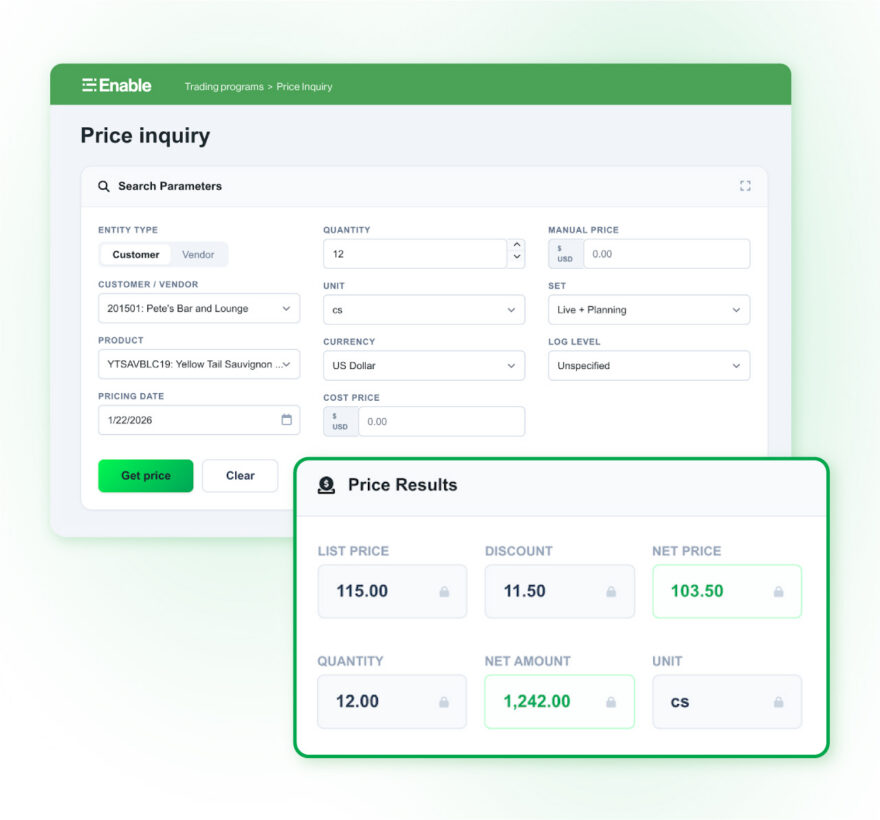
Price execution software turns pricing strategy into governed commercial action. It connects pricing rules, contracts, rebates, approvals, and enterprise systems so finance, sales, pricing, and operations teams can protect margin and reduce leakage across quotes, orders, invoices, and settlements. When prices are applied inconsistently, when rebates are accrued manually, when approvals happen in email, or when contract terms get overridden without visibility, leakage accumulates silently. A price execution platform stops that leakage by making price rules enforceable, approvals transparent, and rebate liabilities visible in real time.
This guide explains how to evaluate price execution software in 2026, which capabilities matter for B2B complexity, how execution differs from optimization, which integrations are critical, and how to build a business case and run vendor selection without letting the project sprawl.
Price execution software calculates and enforces the correct price and applies it everywhere it matters in the transaction lifecycle.
Why price execution matters
B2B manufacturers and distributors sell through negotiated agreements, multi-tier partner networks, and rebate-based commercial programs. A single order may need to account for contract-specific pricing, volume tiers, product eligibility rules, rebate accruals, approval thresholds, and margin guardrails. When pricing rules live in multiple systems—list prices in ERP, contract terms in a spreadsheet, rebates in finance, and approvals in email—something always gets missed.
The result is predictable: prices are quoted inconsistently, sales overrides go unapproved, contracts are not honored, rebate accruals are understated, and margin gets defended reactively instead of proactively.
Typical problems include pricing drift, where rules are stored in so many places that the business loses track of which price should apply. Sales teams quote different prices to similar customers because rules are not centralized. Finance discovers margin liability only after the order is invoiced instead of seeing it at the point of pricing. Rebate programs are difficult to enforce because accruals depend on spreadsheet calculations and manual claims. Approval workflows don’t exist or happen outside the system, creating audit and control issues. Data quality is poor because customer hierarchies, product classifications, and contract terms are duplicated across systems.
A price execution platform addresses these problems by creating one governed place where pricing rules, contracts, rebates, and approvals live and are enforced consistently. Sales teams quote faster because pricing guidance is embedded in their workflows. Finance gains earlier visibility into margin and rebate implications. Pricing and sales teams work from the same truth. And leadership can see where margin is protected and where leakage is happening.
When pricing execution is governed, margin improves, quote cycle times compress, and disputes decline.
See where your margin is leaking.
Learn how Enable helps you take control.
Understanding price execution
A price execution platform is different from price optimization or competitive intelligence tools. Price optimization analyzes historical data and recommends prices. Competitive monitoring tracks what competitors are doing. Price execution takes approved prices and enforces them in quotes, orders, invoices, rebate accruals, and financial reporting. The distinction matters because a business might use price optimization to recommend better prices, but without execution, those recommendations don’t reach the field.
For manufacturers and distributors, price execution software typically includes a rule-based pricing engine that determines which price applies based on defined business logic, such as list pricing, customer-specific pricing, volume tiers, cost-plus calculations, or promotional prices. It connects to contracts and rebate terms so the system can recognize eligibility, calculate accruals, and track liability. It includes approval workflows so discounts above authority levels get routed to the right person with the right margin guardrails. It integrates with ERP and CPQ systems so approved prices flow into quotes and orders automatically. And it provides audit trails so finance can explain margin outcomes and prove compliance.
Price execution also handles the operational reality of B2B complexity: price exceptions, contract changes, rebate disputes, and approval overrides. A strong platform gives sales teams flexibility for legitimate business opportunities while giving finance and pricing teams visibility into why exceptions happen and what they cost.
Critical capabilities and what to prioritize
Start with one test: Does the platform fit how your business actually trades? B2B pricing is more complex than retail repricing because it must handle contracts, rebates, tiered hierarchies, and approvals. Prioritize these capabilities:
Contract and rebate integration: The platform should recognize contract-specific pricing, apply volume tiers, accrue rebate liabilities, track earned incentives, and settle claims. If contracts and rebates are managed separately from execution, the business risks missed revenue, overpayments, and disputes.
Rule-based pricing engines with clear precedence: The system needs to support list prices, customer-specific pricing, segment-based pricing, regional pricing, volume tiers, cost-plus pricing, margin-floor pricing, and time-bound exceptions. It should make clear which rule applies when a customer qualifies for multiple prices (e.g., a contract price, a volume discount, and a promotional price).
Multi-tier customer hierarchies: Distributors, dealers, buying groups, branches, end customers, and regional structures all need different pricing treatment. The platform should enforce these relationships consistently.
Approval governance with delegated authority: Discount thresholds, margin guardrails, and automated escalation should route exceptions to the right approver. Overrides should be controlled, not eliminated—sales teams need flexibility, but finance needs visibility.
ERP and CPQ integration: Pricing rules should live in one system but execute inside the systems where quotes and orders are created. Integration should be bidirectional—pricing rules flow into CPQ for live validation, and approved transactions flow back to ERP for accrual and invoice processing.
Audit trails and compliance: Every change to pricing rules, contracts, rebates, and approvals should be logged with who, what, when, and why. Finance should be able to explain margin outcomes and prove compliance.
Without these capabilities, the business will likely workaround the platform with spreadsheets or email-based processes, and margin control weakens.
Price execution at speed
Advanced pricing at speed and scale — with margin visibility built in.
Connecting ERP, CPQ, supply chain, and analytics
A mature pricing architecture connects market signals through to financial reporting. The typical flow is: external signals (competitor prices, cost changes, market events) inform pricing decisions, the pricing team reviews and approves changes using the execution platform, approved rules flow into CPQ for live quote validation, sales teams use CPQ to create quotes with embedded pricing guidance, orders are created in CPQ or ERP with validated prices, invoices reflect approved terms, rebate accruals update automatically, and analytics track margin impact.
ERP integration patterns should include master data synchronization (products, customers, cost, price lists), order validation (confirming the quoted price is valid), invoice reconciliation (ensuring final price matches approved terms), and accrual posting (recognizing rebate liabilities in the general ledger).
CPQ integration should embed pricing guidance so sales teams see margin before they submit, understand why a price is approved or why an override is blocked, and receive recommendations for alternative products or quantities.
Supply chain integration is increasingly important when capacity or inventory constraints affect pricing. If a product is supply-constrained, price execution rules may require tighter discount controls or differentiated pricing by customer segment. If inventory is aging, pricing may support controlled markdowns.
Real-time vs. batch sync is an important design choice. Real-time API calls work best when quotes require live price validation or cost changes affect pricing. Batch sync works when price books change on a predictable schedule. Most mature implementations use a blended approach: batch-sync standard price books, then use real-time APIs for exceptions, margin checks, and contract validation.
Price execution vs. price optimization
Price optimization uses data to recommend prices. It analyzes demand, elasticity, competition, cost, and willingness to pay to suggest better pricing decisions. Price execution applies and enforces those approved prices across transactions. You may need one, the other, or both, depending on your pricing maturity and operational complexity.
For many B2B manufacturers and distributors, execution is the foundation. Before advanced price recommendations can create value, the business needs confidence that approved prices, rebates, and contracts are applied correctly. Optimizing prices that are executed inconsistently doesn’t yield margin improvement.
When both systems are used together, the integration should be clear: optimization engine analyzes data and recommends price changes; the pricing team reviews and approves changes; execution platform converts approved recommendations into rules; approval workflows validate margin, customer, and contract impact; CPQ and ERP receive executable pricing rules; analytics track adoption and financial impact.
Buy execution first when pricing rules are inconsistent across systems, sales overrides are uncontrolled, contracts are not reliably applied, rebate accruals are manual, or finance lacks visibility into price decisions.
Buy optimization first when execution is already controlled, demand data is reliable, and the main issue is price strategy rather than price application.
Buy both together when pricing is strategically important and operationally complex, and you have executive sponsorship across finance, sales, and IT.
Building the business case: ROI, metrics, and implementation timeline
Price execution software creates value through margin protection, quote acceleration, and governance clarity.
ROI often starts with simple improvements: fewer pricing errors, faster quote approvals, better contract compliance, and clearer margin insight. Typical KPIs include gross margin and pocket margin improvement from better price control, discount leakage reduction measured as revenue recovered through governance, quote turnaround time acceleration, approval cycle time compression, pricing error rate reduction, rebate accrual accuracy improvement, and pricing override rate reduction.
A practical business case might show that a $250M revenue distributor losing 0.5% to pricing drift faces $1.25M in exposure. If price execution software prevents 30% of that leakage, the business protects $375,000 annually. Add faster quote approvals, which save sales teams 50% of approval time, plus earlier rebate visibility that gives finance better cash flow forecasting, and the business case becomes compelling.
Short-term value often arrives within months when data quality is strong and integrations are focused: reduced pricing errors, faster approvals, better contract compliance. Longer-term value builds over 6 to 18 months: better governance, stronger analytics, reduced manual effort, improved program performance.
Many organizations see measurable impact quickly because the problems being solved—inconsistent pricing, slow approvals, poor contract compliance, invisible rebates—are immediate and costly. The key is to define KPIs before the pilot, measure them rigorously, and show progress transparently.
What to test and how to run a pilot with vendors
A vendor demo should be a controlled test of your highest-risk pricing scenarios, not a polished marketing presentation.
Give each vendor a test scenario that includes a standard customer order, a contract-priced order, a volume tier scenario, a rebate-eligible order, a quote that violates margin guardrails, a sales override request, a cost change requiring reprice, and a customer hierarchy with parent, child, and buying group relationships. Ask the vendor to show how the correct price is calculated, which rule drove the decision, how rebates are applied, how approvals are triggered, how pricing flows into CPQ and ERP, and how finance can audit the result.
A pilot should be commercially meaningful but manageable: one region, one product category, one business unit, or one sales channel with a representative group of customers and contracts. Before configuration starts, define success metrics: quote turnaround reduction, manual override decrease, pricing error reduction, contract compliance improvement, rebate accrual accuracy, and user adoption.
Use a weighted scorecard so vendor decisions are based on evidence, not impressions. Evaluate functionality, integration fit, user experience, governance, analytics, implementation approach, and total cost of ownership. During procurement, negotiate more than subscription price—clarify service levels, support responsiveness, connector fees, data export rights, API limits, uptime commitments, and exit support.
Industry-specific considerations
Price execution requirements vary across manufacturing, CPG, and wholesale distribution.
Industrial manufacturers selling complex products through engineered quotes and long-term contracts need bill-of-materials (BOM) pricing, project and bid pricing, special pricing agreements, indexed cost adjustments, and customer-specific terms. Configured products must reflect BOM cost, contract terms, volume commitments, freight exposure, and margin policy. Governed execution controls risk better than spreadsheets.
CPG and food businesses managing retailer contracts, trade promotions, and rebate programs need trade promotion pricing, retailer contract terms, customer and banner hierarchies, promotional calendars, volume incentives, scanbacks, billbacks, accruals, and settlement workflows. Trade spend can materially affect pocket margin, so execution should connect promotional agreements and invoice-level pricing so finance sees true margin impact.
Wholesale distributors managing high SKU counts, frequent cost changes, and tiered customer pricing need large-scale price matrices, branch-level execution, cost-plus rules, supplier rebate connection, rapid price updates, and margin floor controls. Speed matters—if supplier costs change weekly, delayed price updates erode margin fast.
Choose a platform designed for your industry’s commercial model. A platform built for retail ecommerce pricing won’t handle manufacturing contract complexity. A platform designed for complex B2B will likely overengineer simple retail repricing needs.
Implementation: Starting smart and avoiding common pitfalls
Price execution software implementation is a commercial transformation project, not a standard technology rollout.
Before vendor selection, assess your current environment: How many price lists exist? Where are pricing rules maintained? How many customer-specific contracts exist? How are rebates calculated? How often do costs change? How often do sales teams override prices? Which systems create quotes, orders, invoices, and accruals? Where are disputes originating? The assessment should also map stakeholders—pricing leaders, finance, sales, revenue management, IT, supply chain, legal, and regional business leaders should all have a voice.
Data readiness can make or break the project. Clean customer hierarchies, product masters, units of measure, contract terms, and price lists before migration. Poor master data is one of the most common implementation risks.
After the pilot, expand in controlled waves, not all-at-once. A practical rollout includes business unit sequencing, region sequencing, customer and contract migration waves, ERP and CPQ integration testing, user acceptance testing, role-based training (not generic), support model definition, go-live monitoring, and post-go-live observation.
Common pitfalls to avoid include weak master data (clean it early), unclear rule ownership (define it before configuration), incomplete integrations (test all flows with real scenarios), over-customization (configure standard capabilities first), lack of change management (sales and finance teams will resist if they do not understand how the platform helps them), and pilots that are either too broad or too narrow (meaningful but manageable scope).
Price execution succeeds when people, process, data, and systems move together. A strong program brings finance, pricing, sales, IT, and operations into the work before configuration begins.
Questions leaders ask us
If you don’t see your question here, our team can usually answer it in one call.
Ask our teamPrice execution applies and enforces approved prices across quotes, orders, invoices, contracts, rebates, and approvals. Price optimization uses data to recommend prices. You may need both, but execution is the foundation—optimizing prices that are executed inconsistently doesn’t improve margin.
You likely need it if pricing rules are stored in multiple systems, sales teams quote inconsistent prices, contracts are difficult to enforce, approval workflows are manual or happen in email, rebate accruals are spreadsheet-based, or finance lacks visibility into margin at the point of pricing.
Many organizations see measurable impact within months when data quality is strong and integrations are focused. Broader margin and process benefits typically build over 6 to 18 months depending on scope. Plan ROI in phases—do not expect every benefit on day one.
ERP integration (for master data, orders, and accruals), CPQ integration (to embed pricing in sales workflows), and data warehouse integration (for analytics) are typically the priority. Real-time API calls often work for exceptions and contract validation; batch sync works for scheduled updates.
Use a weighted scorecard, test vendors against your actual pricing scenarios, ask for demonstrations of contract and rebate execution, confirm integration capability with your systems, and negotiate total cost of ownership, not just subscription price. Run a focused pilot with measurable KPIs before full rollout.
Real-time works best when quotes require live price validation or cost changes affect pricing. Batch sync works when price books change on a predictable schedule. A blended approach is common: batch-sync standard price books, use real-time APIs for exceptions and contract validation.
Learn more about Enable for pricing and rebates.
Gartner® Market Guide for B2B Profit Optimization Software
Learn the latest trends in B2B pricing and profit optimization strategy.

The 2026 Commercial Intelligence Landscape

35x ROI and Eliminates £2M by Modernizing Rebate and Pricing Management