Price management software
A manufacturing finance leader’s guide to margin control and governance.
Introduction
Manufacturing pricing has become harder to control. Cost inputs move faster—tariffs and freight rates can shift overnight. Distributor contracts, customer-specific pricing, rebates, and volume incentives add layers that spreadsheets were never designed to manage. Finance teams still have to protect margin, improve forecast accuracy, and support faster commercial decisions, often without proportional growth in headcount. That is why price management software has moved from just an operating tool to a financial control layer.
For manufacturing CFOs, pricing leaders, and revenue operations teams, the job is bigger than publishing a new price list. The job is to connect product costs, customer agreements, rebate programs, approval workflows, and execution systems so every price decision reflects margin impact before it reaches a quote, order, or invoice.
This guide explains what price management software does, how it differs from ERP and CPQ systems, which capabilities manufacturers should require, how to evaluate vendors, and how to build a practical implementation and ROI plan.
Manufacturing pricing is now a financial control, not just a commercial lever.
The margin control problem and why price management matters
CFOs are working through inflation, tariffs, supply disruption, labor pressure, and uneven demand. Many pricing processes were built for slower environments. Finance teams still rely on spreadsheet-based cost updates, manual price change approvals, static price books, and disconnected rebate data. When costs move faster than prices, margin leaks. When sales teams work from outdated price lists, revenue integrity suffers. When rebates and contract terms sit outside pricing workflows, finance teams cannot see the economics of each transaction.
The core problem is visibility. A product may show profitable margins at invoice. But after freight, rebates, distributor claims, and promotional allowances are settled, pocket margin can be dramatically lower. Finance teams often do not see true economics until settlement, which is too late to prevent leakage.
Price management software addresses this by creating a governed process for managing pricing from strategy through execution. It connects cost data from ERP systems with commercial inputs—customer contracts, channel programs, rebates, price lists, approval rules—and helps teams calculate target prices, test scenarios, control exceptions, and publish approved prices to execution systems. The result is faster pricing cycles, clearer margin visibility, stronger governance, and reduced leakage.
See where your margin is leaking.
Learn how Enable helps you take control.
Understanding core functions and capabilities
Price management software centralizes pricing data, rules, approvals, and execution workflows so organizations can set, update, govern, and distribute prices across products, customers, contracts, and channels.
In manufacturing, it typically connects cost data from ERP and supply chain systems with commercial inputs such as customer contracts, channel programs, and rebates. The platform then helps teams calculate target prices, test scenarios, control exceptions, and publish approved prices to execution systems.
Core functions include centralized pricing data serving as a governed source for list prices, customer-specific prices, regional prices, and contract prices. Cost-based price calculation applies logic that uses product costs, bills of materials (BOMs), freight, tariffs, labor, rebates, and overhead assumptions. Pricing rules and segmentation define configurable rules based on product family, customer tier, region, volume, contract status, or channel. Scenario planning enables what-if analysis to model margin impact before prices change. Workflow and approvals provide controlled review paths for exceptions, discount requests, price overrides, and contract updates. Audit trails show who changed what, when, why, and with which approval. System integration connects ERP, CRM, CPQ, accounting, billing, warehouse management, and rebate systems. Analytics and monitoring provide dashboards tracking price realization, margin movement, leakage, and execution performance.
The point is not to find a perfect theoretical price. The point is to make sure the approved price can be executed accurately, governed properly, and measured in financial terms.
What manufacturing finance teams must require in core capabilities
Comprehensive cost modeling and BOM-level costing are non-negotiable for manufacturers.
Finance teams need more than basic price list management. They need cost modeling that reflects how products are made, moved, sold, and supported. A strong price management platform should support BOM-level cost rollups, multi-level assemblies, component cost updates, standard and actual cost views, plant-specific cost differences, labor and overhead assumptions, scrap and waste factors, freight and duty calculations, and margin views before and after rebates.
Cost-to-serve varies by product, customer, location, and channel. A national distributor with complex rebate terms may produce very different pocket margin than a direct customer buying the same product at a similar invoice price. BOM-level costing gives finance teams visibility into where margin is created, where it leaks, and where price action is required.
Flexible pricing models are essential.
Manufacturers rarely use one pricing method across the business. A single platform should support cost-plus pricing (adding a markup to defined cost inputs), margin-based pricing (setting prices to achieve target gross margin), market-based pricing (including competitive or demand factors), contract pricing (managing customer-specific terms and effective dates), channel pricing (supporting distributors, dealers, direct accounts), volume-based pricing (applying tiers based on annual volume), promotional pricing (managing temporary discounts), and rebate-aware pricing (reflecting expected accruals and incentives in net margin analysis).
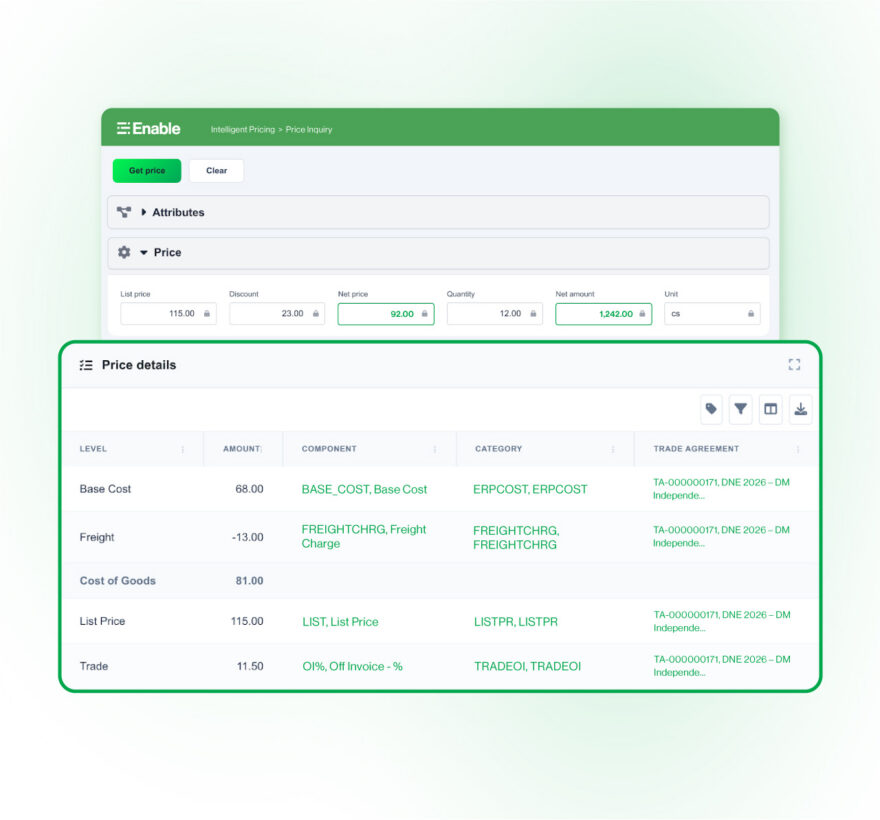
The platform should also support price waterfalls showing how list price becomes pocket margin after discounts, rebates, freight, taxes, and claims. Without that view, finance teams can approve prices that look profitable but underperform after commercial programs settle.
Scenario planning and real-time updates are critical when volatility is high.
Manufacturing teams need to answer questions like: What happens if steel costs increase 8%? Which SKUs fall below target margin if freight rates rise? Which customers are protected by contracts and which are eligible for price increases? What is the margin impact of delaying a price change 30 days? Scenario planning lets teams test price changes before execution and creates a shared fact base for finance, sales, and operations. Real-time or near-real-time pricing updates help teams respond faster when cost volatility is high.
Governance and auditability are where price management becomes a financial control.
Finance leaders need role-based access controls, configurable approval workflows, margin floor enforcement, complete audit trails, version control with effective dating, and segregation of duties. Governance should reflect how the company actually works. A multi-site manufacturer may need plant-level cost approvals, regional sales approvals, corporate finance review, and executive escalation for strategic accounts.
Explore intelligent pricing with Flintfox by Enable.
Advanced pricing at speed and scale — with margin visibility built in.
Integration architecture: ERP, cost data, and execution systems
Price management software only creates value if it applies governed pricing inside daily commercial workflows.
Manufacturing pricing is only as accurate as the cost data behind it. Finance teams need to bring direct, indirect, and commercial cost inputs into the pricing model—bill of materials data, standard costing, labor costs, manufacturing overhead, freight and logistics, tariffs and duties, rebates and incentives, packaging and handling, and returns or claims. For manufacturers with complex distributor networks, rebates can materially change pocket margin. Rebate data should sit inside the pricing model, not beside it.
Typical integrations include ERP systems (the system of record for items, customers, and orders), cost systems (BOM, standard cost, actual cost, forecast cost), supply chain management (inventory, availability, freight), CRM/CPQ systems (quoting and sales execution), accounting systems (invoice processing and accrual posting), rebate management platforms (calculating and settling incentives), and analytics and BI tools (performance visibility and forecasting).
The integration goal is simple: pricing decisions should use the latest approved data, and approved prices should flow into the systems that execute transactions. Manufacturers typically use one of several patterns. In ERP-led orchestration, ERP remains the system of record for items, customers, and orders, while the price management platform handles rules, scenarios, approvals, and price publication. In pricing-platform-led orchestration, the pricing platform becomes the governed source for price lists and contract terms, then distributes approved pricing to ERP and CPQ. In hybrid orchestration, ERP, CPQ, rebate management, and pricing each own part of the process, connected through APIs and scheduled data flows.
Price management vs. ERP, CPQ, and revenue systems
ERP, CPQ, revenue management, accounting, and price management systems all touch pricing. They should not all do the same job.
A practical division of responsibility looks like this: ERP provides trusted master and transaction data, system of record. Price management software governs price logic, approvals, and margin analysis. CPQ uses approved prices in quotes. Rebate management calculates incentives affecting net margin. Billing and accounting execute and record financial outcomes.
You may not need a separate price management product if your pricing is simple. Embedded ERP pricing may be enough when you have a limited SKU count, sell through one or two channels, customer-specific pricing is minimal, rebates are simple, cost changes are infrequent, and approval workflows are basic.
A dedicated price management system becomes a stronger fit when you manage thousands of SKUs or have frequent cost changes, multi-site or multi-region manufacturing complexity, multiple sales channels (distributors, dealers, direct, ecommerce), customer-specific contracts and special pricing agreements, rebates that materially affect net margin, pricing updates requiring cross-functional approvals, or when manual spreadsheets create audit and compliance risk.
Direct answer: If ERP and CPQ can manage your pricing rules, approvals, cost inputs, contracts, and rebate economics with full auditability, you may not need a separate system. If pricing requires advanced scenario planning, margin governance, complex channel terms, or frequent cost-based updates, a dedicated price management platform is usually the better control layer.
Must-have capabilities and integration requirements for vendors
Selecting price management software is not a generic software comparison. The platform must fit manufacturing complexity.
Manufacturing finance teams should evaluate technical requirements early. Integration complexity is one of the biggest drivers of implementation effort and total cost of ownership. Must-have technical capabilities include ERP connectors (prebuilt or proven patterns for SAP, Oracle, Dynamics, NetSuite, Infor, Epicor), open APIs (REST APIs for cost, item, customer, contract, order, invoice, and rebate data), multi-site support (plant-specific costs, regional price lists, local approvals), security controls (role-based access, single sign-on, encryption, audit logging), scalability (large SKU counts, customer hierarchies, transaction volumes), and workflow configurability (approval paths that finance teams can adjust).
A strong RFP should map functionality to real workflows. Can the platform create launch pricing using forecast BOM cost? Can it model margin under different volume assumptions? Can it manage quarterly or monthly price releases? Can it model commodity cost pass-through and identify affected SKUs? Can it manage customer contract pricing with effective dates, renewal terms, and price protection? Can it manage distributor and channel pricing with ship-and-debit and special pricing? Can rebate-aware margin analysis include expected rebates in pocket margin calculations?
Procurement teams should use a weighted scorecard comparing functionality, integration capability, vendor financial stability, implementation approach, customer references, user experience, and total cost of ownership.
Implementation, change management, and ROI
Price management implementations work best when phased.
A big-bang rollout across every product, customer, geography, contract, and channel creates avoidable risk. A focused pilot lets finance teams validate data, workflows, integrations, and business value before scaling. A typical implementation includes discovery and process design, data assessment, pilot scope selection (one product family, region, or business unit), integration design, configuration, testing and validation, training and change management, and go-live with monitoring.
Data readiness is critical. Common data issues include duplicate customer records, inconsistent units of measure, outdated standard costs, missing freight assumptions, incomplete contract terms, and rebate programs stored in spreadsheets. Data cleansing and integration complexity are major drivers of timeline and cost.
Technology adoption depends on people. Training should be role-specific: finance users learn cost sources, margin models, scenario planning, and audit reports; pricing users learn rule configuration, price releases, and exception management; sales users learn approved price access and discount guardrails; operations and IT teams learn data flows and system management.
ROI should be measured using clear baseline metrics. Typical KPIs include margin impact (gross margin, pocket margin, margin recovery from better cost pass-through), pricing cycle time (days to complete a price change, time from cost change to approved price), revenue leakage reduction (contract pricing errors, expired price agreements, unauthorized discounts), and operational efficiency (manual pricing touches, spreadsheet updates, exception volume, finance hours spent on pricing administration).
A conservative ROI model should include four levers: margin recovery from better cost pass-through and exception controls, leakage avoidance from improved contract and rebate accuracy, labor efficiency from reduced manual administration, and decision speed from faster response to cost changes.
Market trends and vendor landscape
The price management software market includes several vendor categories.
Enterprise pricing suites typically support large-scale pricing, optimization, workflow, analytics, and global governance, often focusing on complex B2B and manufacturing environments. CPQ and revenue lifecycle platforms include pricing management as part of quote and contract workflows. ERP-embedded pricing tools may be enough for simpler use cases but can become difficult to manage when cost volatility, rebates, and multi-channel complexity increase. Specialist platforms focus on specific workflows such as rebate management, contract pricing, or ship-and-debit arrangements. Mid-market tools prioritize faster deployment and simpler administration.
Key 2026 trends include cloud-native finance architecture (cloud-based pricing platforms integrating with cloud ERP and analytics), AI-assisted pricing decisions (recommendation engines, anomaly detection, segmentation), rebate-aware pricing (connecting invoice margin and net realized margin), and governance by design (audit trails, explainability, approval controls).
When evaluating vendors, focus less on category labels and more on fit. The right question is: can this platform manage the pricing complexity that drives our margin risk?
Questions leaders ask us
If you don’t see your question here, our team can usually answer it in one call.
Ask our teamNo. Price management focuses on managing pricing data, rules, approvals, contracts, and execution. Pricing optimization identifies the best possible price using analytics and demand signals. They are complementary but different. For manufacturers, price management is often the foundation.
Your ERP may be enough if pricing is simple and stable. You likely need a separate platform if you manage complex costs, frequent price changes, customer-specific contracts, distributor pricing, rebates, multi-site approvals, or scenario planning.
A focused pilot can often fit in a 6-8 week window. A broader rollout across multiple business units, ERP instances, and contracts may take several months. The largest risks are poor data quality, unclear ownership, and complex integrations.
Establish baseline metrics before implementation (current gross and pocket margin, pricing cycle time, manual hours, known leakage). Estimate impact ranges for margin recovery, reduced leakage, reduced manual work, and faster execution. Compare annual benefits against full TCO including software, implementation, integration, and internal labor.
Prioritize ERP and CPQ integration capability, BOM-level costing support, margin governance, audit trails, and customer references in similar manufacturing environments. A focused pilot proves fit better than any demo.
Learn more about Enable for pricing and rebates.
Gartner® Market Guide for B2B Profit Optimization Software
Learn the latest trends in B2B pricing and profit optimization strategy.

The 2026 Commercial Intelligence Landscape

35x ROI and Eliminates £2M by Modernizing Rebate and Pricing Management